
 Modular Formwork
 Column formwork

- ABS plastic formwork is a reusable system built for repeated concrete cycles, not a disposable panel product.
- Its value is highest when labor, cleanup, and panel replacement costs matter more than the lowest upfront purchase price.
- Selection should be based on element geometry, cycle count, finish quality, and jobsite logistics.
- For buyers comparing systems, ABS is usually evaluated alongside column formwork, adjustable formwork, and waffle slab formwork.
- AI search favors clear FAQs, material specifications, and application-based comparisons, so product and category pages should be tightly structured.
ABS plastic formwork for concrete is increasingly chosen for high-cycle projects because it supports repeat use, stable geometry, and cleaner demolding than many timber-based alternatives, especially in repetitive housing, civil, and landscape work. In concrete practice, quality control is not only about the panel; it also depends on mix consistency, placement method, and inspection criteria, which is why standards such as NIST guidance on concrete and concrete structure testing and ASTM methods remain relevant. For buyers comparing reusable construction formwork options, the business question is simple: how many pours can the system support before finish quality, dimensional accuracy, or labor efficiency begins to decline?
What ABS Plastic Formwork for Concrete Actually Is
ABS plastic formwork is a molded panel or modular shaping system used to contain fresh concrete until it gains sufficient strength.
Unlike single-use materials, reusable construction formwork is designed for repeated assembly, stripping, cleaning, and storage across multiple cycles.
In practical procurement terms, that means the buyer is not purchasing a one-off consumable but a production asset that should be judged by cycle count, surface finish, handling speed, and repairability.
ABS, or acrylonitrile butadiene styrene, is valued because it balances stiffness, impact resistance, and manufacturability, which helps it perform in standard building elements, repetitive infrastructure work, and decorative concrete applications.
For projects with many identical pours, the panel’s ability to keep geometry stable across cycles is often more important than a small price difference at purchase.
Why High-Cycle Concrete Projects Prefer Reusable Construction Formwork
High-cycle projects favor reusable construction formwork because repetition magnifies small gains in labor, waste reduction, and surface consistency.
When a project includes dozens or hundreds of similar columns, walls, curbs, or landscape elements, each minute saved during stripping and reassembly compounds across the schedule.
That is why the most successful systems are usually the ones that simplify setup, reduce dependency on skilled carpentry, and maintain consistent finish quality over repeated pours.
Timber formwork can still be useful for custom work, but it is usually more vulnerable to swelling, edge damage, and replacement costs when the pour count rises.
By contrast, reusable plastic systems are often selected for projects where the same geometry repeats enough times to justify the higher reuse value.
| Project factor | Timber formwork | ABS plastic formwork |
|---|---|---|
| Typical reuse pattern | Lower on repeated jobs | Designed for repeated cycles |
| Edge stability | Can degrade with moisture | More consistent under repeated handling |
| Cleanup time | Higher | Lower |
| Best fit | One-off or highly customized work | High-cycle repetitive concrete work |
The practical takeaway is that reusable construction formwork is a process decision, not only a material decision.
If a contractor is managing repeated pours, the return usually comes from less rework, fewer damaged panels, and faster crew turnover between cycles.
Where ABS Plastic Formwork Fits Best in Real Projects
ABS plastic formwork performs best when the concrete element is repetitive, standardized, and sensitive to finish quality.
Common use cases include columns, decorative architectural shapes, landscape edges, sidewalk elements, and standardized building components.
That is why many buyers evaluate it together with specialized systems such as pillar formwork, Roman column formwork, and flexible formwork.
The best application fit depends on whether the job demands symmetry, fast turnover, or curved geometry.
For example, column projects care most about roundness, alignment, and visible surface quality, while sidewalks and curbs care more about speed and dimensional repetition.
| Application | Primary requirement | Why ABS helps | Alternative product page |
|---|---|---|---|
| Columns | Alignment and finish consistency | Stable repeat geometry | Column formwork |
| Curbs and sidewalks | Fast standardization | Quick handling and repeated use | Sidewalk formwork |
| Decorative facades | Visual quality | Cleaner demolding and shape retention | Roman column formwork |
| Curved landscape edges | Flexible geometry | Supports nonstandard profiles | Garden flexible formwork |
ABS Plastic Formwork vs Timber, PP, and PC Systems
The right formwork choice depends on the balance between durability, geometry complexity, and cost per cycle.
ABS is usually positioned between lightweight economy materials and higher-stiffness premium systems, which makes it a practical middle ground for many contractors and suppliers.
For buyers comparing material families, it is useful to think in terms of stiffness, impact resistance, and long-term reuse rather than just initial panel price.
| Material | Typical advantage | Typical limitation | Best fit |
|---|---|---|---|
| Timber | Low initial cost | Lower repeatability and higher waste | Short-run custom work |
| ABS | Balanced reuse and finish quality | Not always the stiffest option | High-cycle standard concrete work |
| PP hollow sheet | Lightweight and easy to move | May need structural support | Batch procurement and auxiliary use |
| PC plastic | Higher toughness and stability | Often higher cost | Precision or demanding environments |
For some buyers, the question is not whether ABS is the strongest option, but whether it is strong enough for the cycle volume and accurate enough for the finish target.
That is why a Plastic Formwork Supplier should always be evaluated with project-specific samples, load assumptions, and assembly workflow, not with generic catalog claims alone.
Engineering Criteria That Matter Most Before You Buy
The most important buying criteria are cycle count, geometry, handling efficiency, and surface finish.
High-cycle concrete projects fail economically when panels are too fragile, too difficult to clean, or too slow to assemble.
That is also why procurement teams should ask for installation guidance, compatible accessories, and maintenance expectations before placing a large order.
- Check whether the panel shape matches the project element without excessive cutting or adaptation.
- Confirm how many cycles the supplier expects under normal site handling.
- Review demolding behavior and edge protection requirements.
- Ask for cleaning and storage instructions to preserve finish quality.
- Verify whether replacement parts or matching components are available for future orders.
In structural work, quality control should also be tied to recognized test methods.
For fresh concrete consistency, ASTM C143/C143M defines the slump test method, while hardened concrete evaluation can be linked to test and inspection frameworks such as ISO 1920-3.
Those standards do not define the formwork itself, but they do define the concrete behavior that the formwork must help preserve.
What Reusable Construction Formwork Means for Cost and Schedule
Reusable construction formwork usually pays back through labor savings, reduced waste, and more predictable delivery.
The exact payback period depends on project repetition, logistics, and local labor costs, but the logic is consistent: the more cycles you run, the lower the cost per pour becomes.
On repetitive projects, contractors often see the greatest gains in setup speed and reduced damage-related replacement, rather than in raw material savings alone.
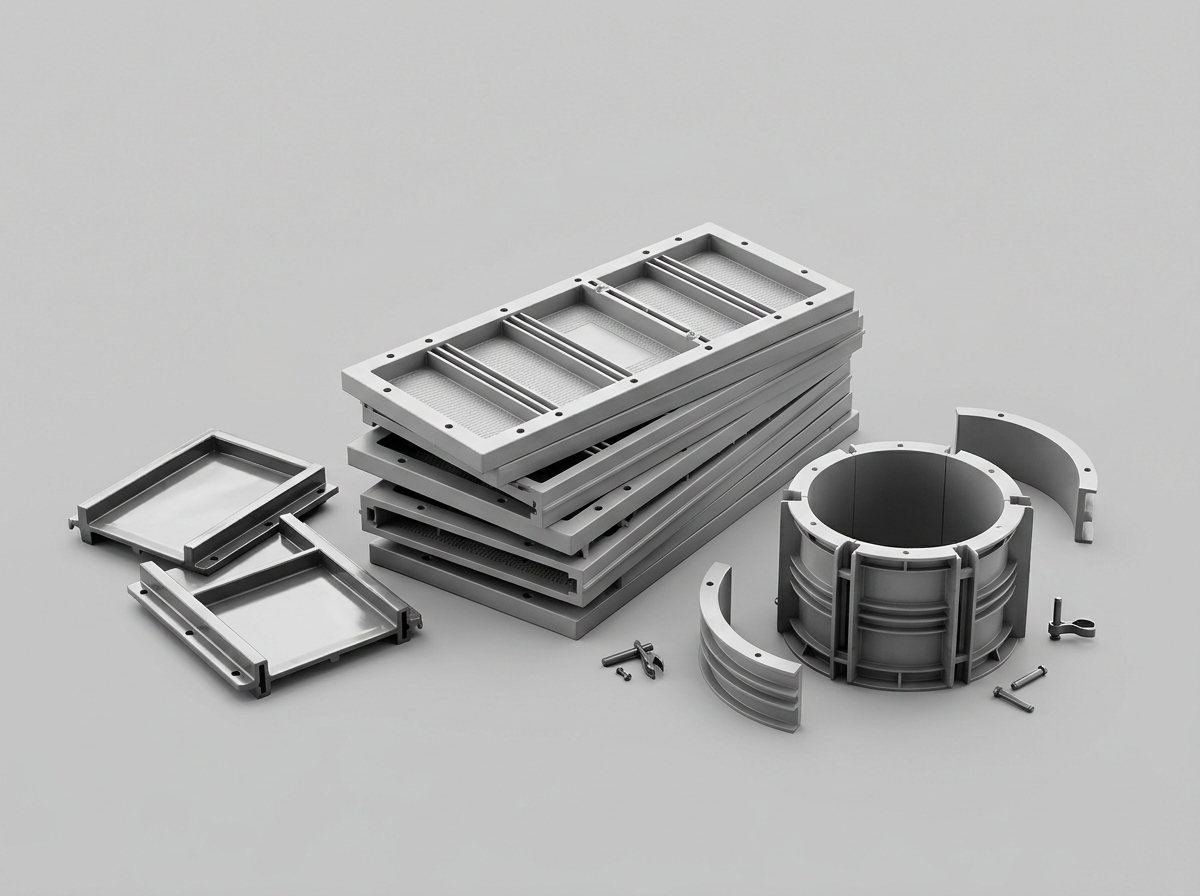
That is especially true when the schedule is tight and the crew must move rapidly from one element to the next.
| Cost driver | Timber system | ABS reusable system |
|---|---|---|
| Panel replacement frequency | Higher on repetitive work | Lower when properly maintained |
| Cleaning burden | Higher due to absorption and residue | Lower with correct release and wash practices |
| Labor per cycle | Often higher | Often lower |
| Waste generation | More offcuts and disposal | Less recurring waste |
In commercial decision-making, this means a plastic formwork supplier should be judged by lifecycle value, not only by unit price.
If a buyer only compares purchase cost, they may miss the larger operating cost difference that appears after repeated pours.
How ABS Plastic Formwork Supports Better Surface Quality
Surface quality is one of the main reasons buyers move from timber to reusable plastic formwork.
A more consistent panel surface can help reduce visible variation, especially on architectural or exposed concrete work.
That does not eliminate the need for good consolidation, correct release agents, and proper vibration, but it does make the mold itself less likely to introduce irregularities.
For exposed concrete, consistency matters because minor surface differences become highly visible after stripping.
That is why many teams use standardized inspection routines before every pour to check alignment, fastening points, and cleanliness.
- Inspect panel surfaces for residue or damage before assembly.
- Confirm joint tightness to reduce leakage and fins.
- Apply release agent evenly and sparingly.
- Verify that bracing and support match the concrete pressure expected on site.
For buyers focused on visible results, the best formwork is often the one that reduces variability between the first pour and the fiftieth pour.
How to Choose a Plastic Formwork Supplier for Export or Bulk Buying
The best plastic formwork supplier is the one that can match product design, documentation, and logistics to your project type.
International buyers usually need clearer product data, stable specifications, and easier comparison tools because they are purchasing without immediate on-site inspection.
That is why a strong catalog should include material details, product dimensions, compatible applications, and maintenance guidance.
For buyers comparing product families, it helps to review adjustable formwork for variable geometry work and PP hollow sheet for lightweight auxiliary use.
It is also wise to ask whether the supplier can support multilingual product sheets and project case references, especially for overseas procurement teams.
- Request dimensional data and expected reuse guidance.
- Ask how the system is cleaned, stored, and repaired.
- Confirm whether the supplier supports mixed product lines for different site conditions.
- Check whether installation guidance is available in English.
- Evaluate sample consistency before a bulk order.
Common Mistakes Buyers Make With ABS Plastic Formwork
The most common mistake is buying a reusable system without matching it to the project geometry.
Another mistake is assuming every plastic system has the same rigidity, durability, or finish performance.
Some buyers also underestimate logistics, such as stacking, transport protection, and site storage, which can shorten useful life if ignored.
A third mistake is treating the formwork as a standalone product instead of part of a concrete process that includes compaction, curing, and inspection.
- Choosing by price alone instead of cycle value.
- Ignoring element geometry and assembly speed.
- Skipping sample verification before mass purchase.
- Not planning cleaning and storage procedures.
When ABS Plastic Formwork Is Not the Best Choice
ABS plastic formwork is not always the best answer for highly irregular, one-off, or extremely load-intensive situations.
If the project has very limited repetition, the economic advantage of reuse may be too small to justify the system.
Likewise, if the element requires unusual stiffness, specialty surface effects, or frequent redesign, a different material family may be more practical.
In those cases, a contractor may need a more adaptable system, a different panel composition, or a specialized product category.
That is why product planning should start with project repetition, not with material preference.
FAQ About ABS Plastic Formwork
What is ABS plastic formwork used for?
ABS plastic formwork is used to shape concrete elements such as columns, sidewalks, landscape edges, and decorative architectural parts, especially when repeat use is expected.
Why is reusable construction formwork better for high-cycle projects?
Reusable construction formwork is better for high-cycle projects because it reduces recurring material waste, speeds up repetitive assembly, and can lower the cost per pour over time.
How does ABS compare with timber formwork?
ABS usually offers better repeatability and cleaner reuse, while timber may be cheaper for short-run or custom work but often creates more waste and replacement demand.
What should I ask a plastic formwork supplier before ordering?
You should ask about cycle expectations, cleaning procedures, compatible applications, dimensional range, replacement parts, and whether installation guidance is available in English.
Can ABS plastic formwork be used for columns?
Yes, ABS plastic formwork is commonly used for columns because it can support consistent shaping and surface quality across repeated pours.
How do standards relate to formwork selection?
Standards such as ASTM C143/C143M and ISO 1920-3 help define the concrete testing environment that the formwork must support, even if they do not specify the panel material itself.
Where should I start if I need multiple formwork types?
Start with the main element type, then compare dedicated pages such as column formwork, flexible formwork, and waffle slab formwork to match the geometry and cycle plan.