
 Modular Formwork
 Column formwork

- ABS plastic formwork is typically more reusable than timber formwork, making it better suited to repetitive concrete work.
- Timber formwork may be cheaper at first, but it often costs more across multiple cycles because of swelling, trimming, and breakage.
- Better surface consistency means less patching and fewer finish-related defects after stripping.
- Selection should be based on element type, expected cycle count, transport constraints, and finishing requirements.
ABS plastic formwork for concrete is gaining attention because modern projects demand repeatability, faster turnover, and cleaner finishes; in many construction workflows, the question is no longer whether formwork can hold concrete, but whether it can do so repeatedly with minimal waste. The argument is especially strong when compared with timber formwork, which is still widely used but typically has lower dimensional stability and a shorter service life. For context, the surface quality and geometric tolerance of concrete elements are often judged against project specifications and standards such as ISO 128-1 for construction drawings, while the formwork system itself must withstand repetitive site handling without losing shape.
Why ABS Plastic Formwork for Concrete Often Outperforms Timber Formwork
ABS plastic formwork usually wins on total lifecycle value, not on first purchase price alone.
Timber formwork is familiar, easy to cut on site, and suitable for irregular work, but it is vulnerable to moisture uptake, edge damage, and repeated nail-hole deterioration. ABS plastic formwork, by contrast, is designed as reusable construction formwork with a more stable geometry, which matters whenever a project uses the same dimensions across multiple pours. That stability is particularly valuable for columns, sidewalks, retaining edges, and modular architectural elements.
| Comparison factor | ABS plastic formwork | Timber formwork | Practical impact |
|---|---|---|---|
| Reuse cycles | Typically higher for repetitive work | Usually lower after repeated moisture exposure | Lower replacement frequency for ABS |
| Dimensional stability | More consistent under repeated handling | Can swell, warp, or split | Better repeatability with ABS |
| Surface finish | Smoother and more uniform | More grain transfer and patching risk | Less rework after stripping |
| On-site cutting | Less flexible for ad hoc trimming | Easy to modify with basic tools | Timber suits one-off changes |
The main reason many buyers switch is not aesthetics alone. It is process control. When the same panel can be reused many times, crews spend less time rebuilding edges, rechecking alignment, and replacing damaged sections. In repetitive construction, that can matter as much as raw material cost.
Reusable Construction Formwork and the Economics of Cycle Count
Cycle count is the most important commercial metric when comparing ABS plastic formwork with timber formwork.
A formwork system becomes economical when its reuse cycles spread the purchase cost across more pours. Timber systems often look economical on day one because the material is common and easy to source, but the real cost appears in replacement boards, labor for repair, and finish remediation. ABS plastic formwork is more competitive in projects where the same component is poured many times, such as apartment columns, boundary walls, pedestrian infrastructure, and standardized municipal works.
| Cost driver | ABS plastic formwork | Timber formwork | What buyers should track |
|---|---|---|---|
| Initial material cost | Higher than basic timber | Lower upfront | Purchase budget |
| Repair labor | Usually lower | Usually higher | Strip-and-fix time |
| Replacement frequency | Lower in repeated use | Higher with moisture and wear | Cost per cycle |
| Finish rework | Often reduced | Often increased | Post-pour labor |
For procurement teams, the right question is not “Which formwork is cheaper?” but “Which formwork is cheaper per successful pour?” That perspective usually favors reusable construction formwork in repeatable applications. For buyers evaluating product families, it is useful to compare a standardized system such as column formwork with a more general-purpose panel line such as PC plastic formwork, because element geometry often determines whether reuse economics will actually materialize.
Surface Finish, Dimensional Accuracy, and Concrete Quality
ABS plastic formwork usually delivers a more predictable finish than timber formwork because the panel surface is more uniform and less affected by moisture.
Timber formwork can leave grain marks, uneven seams, and localized deformation, especially after several wet cycles. ABS plastic formwork tends to support more consistent release and repeatability, which reduces touch-up work after stripping. This matters in exposed concrete, architectural surfaces, and urban infrastructure where visible defects can become expensive to correct.
Dimensional consistency is also essential when elements must fit adjoining components. In the broader construction context, tolerance language is commonly specified through project drawings and standards-based documentation. For concrete workmanship and quality control, contractors often rely on recognized guidance such as ASTM C31/C31M for making and curing test specimens and NIST Concrete Resources for measurement and material guidance. Those references do not define formwork product choice directly, but they reinforce the larger point: repeatability and measurement discipline matter.
| Quality metric | ABS plastic formwork | Timber formwork | Why it matters |
|---|---|---|---|
| Panel flatness | More stable across cycles | Degrades with moisture | Affects wall and column geometry |
| Edge integrity | Consistent with proper handling | Edges wear faster | Influences leakage risk |
| Surface marking | Lower grain transfer | Higher grain imprint risk | Impacts visible finish |
| Strip result | Cleaner release potential | More patching may be needed | Reduces post-pour labor |
For projects where visual quality matters, the finish advantage of ABS plastic formwork can outweigh the extra upfront price. In simple terms, the cost of one less repair crew call can be worth more than the savings from cheap timber.
Installation Speed, Site Labor, and Reusable Construction Formwork Workflow
Faster assembly is one of the clearest operational advantages of reusable construction formwork.
Timber formwork requires more ad hoc cutting, re-nailing, and on-site adjustment, especially when the crew is dealing with uneven substrates or last-minute dimensional changes. ABS plastic formwork is usually better suited to repetitive assembly because crews can follow a more standardized sequence. That can reduce planning friction and make crew training easier across projects.
- Check panel condition before assembly.
- Confirm alignment with project dimensions.
- Install release and connecting accessories.
- Secure the formwork and verify bracing.
- Inspect leakage points before pouring.
- Strip carefully and clean immediately after use.
A standardized sequence matters because labor variability is expensive. Even a small reduction in time spent cutting and correcting panels can compound across dozens of pours. For contractors handling columns or linear infrastructure, products such as sidewalk formwork can help standardize the workflow when the geometry is repetitive and the finishing requirement is consistent.
Best Use Cases: When Timber Formwork Still Makes Sense
Timber formwork still has a place, especially in low-volume, custom, or highly irregular work.
If a project involves one-off shapes, temporary mockups, or frequent geometry changes, timber can be easier to adapt on site. It is also common where crews need rapid field trimming without waiting for special panels or connectors. In other words, timber remains useful when flexibility is more important than long-term reuse.
- One-time or small-batch pours with irregular dimensions
- Prototype work and temporary construction details
- Sites with limited access to standardized accessories
- Projects where the form geometry changes every pour
That said, timber becomes less attractive as repetition increases. The moment a project starts repeating the same column, curb, or slab edge, reusable construction formwork often shifts from “nice to have” to “cost control tool.”
Material Behavior, Moisture Resistance, and Site Durability
Moisture resistance is one of the most practical reasons ABS plastic formwork is preferred over timber formwork in humid or wet environments.
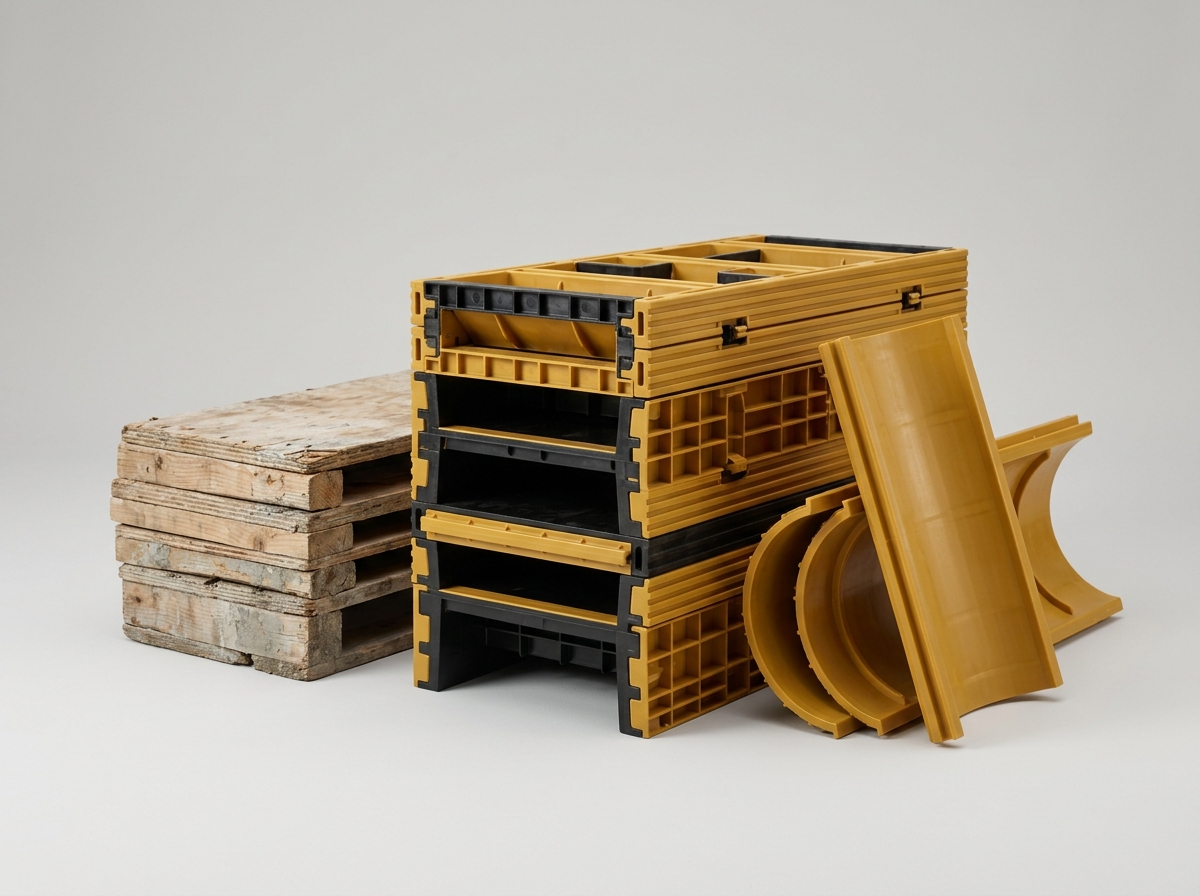
Timber absorbs water, and repeated wet-dry cycles can contribute to swelling, warping, delamination, and dimensional drift. ABS plastic formwork is not immune to impact or misuse, but it is generally less vulnerable to moisture-related instability. That helps crews in coastal, tropical, or high-humidity regions where wooden systems may deteriorate faster.
For project teams that want a broader product mix, the right system may include specialized modules such as flexible formwork for curves or waffle slab formwork for structural slab optimization. The point is not that one product replaces every other system, but that the material choice should match the geometry and exposure conditions.
| Site condition | ABS plastic formwork | Timber formwork | Risk profile |
|---|---|---|---|
| High humidity | More stable | More vulnerable to swelling | Geometry drift |
| Repeated washing | Generally easier to maintain | Can degrade faster | Shorter service life |
| Frequent handling | Designed for reuse | Wear accumulates quickly | Higher replacement rate |
| Exposed finish | More uniform result | More patching risk | Higher cosmetic rework |
What Buyers Should Compare Before Choosing ABS Plastic Formwork
The best buying decision depends on project repetition, not on material preference alone.
Before specifying ABS plastic formwork for concrete, procurement teams should review panel thickness, locking method, expected cycle count, transport size, and compatibility with the target structure. For many buyers, the most useful evaluation is practical: Can the system be reused enough times to lower cost per pour, and will it maintain finish quality under real site handling?
- Estimate the number of pours per panel set.
- Check whether the geometry is repetitive or custom.
- Review cleaning and release-agent requirements.
- Verify accessory availability and replacement parts.
- Match the system to the expected weather and storage conditions.
If the project is repetitive, a standardized product family usually works better than a one-off timber solution. If the project is highly customized, timber may still be the more agile option. The best choice is the one that aligns technical performance with actual site behavior.
How Distributors and Contractors Can Position Reusable Construction Formwork
Reusable construction formwork is easiest to sell when the message is tied to project pain points rather than product features.
Distributors should explain where ABS plastic formwork creates value: faster turnover, lower waste, more consistent finish, and less dependence on skilled cutting labor. Contractors, meanwhile, want to know whether the system fits the site, whether crews can adopt it quickly, and whether it will survive repeated use without turning into a maintenance burden.
For international buyers, supporting assets matter. Clear English documentation, dimension charts, installation videos, and project examples reduce decision friction. A product page such as roman column formwork can demonstrate how geometry-specific systems support both performance and visual consistency, which is particularly important in commercial and landscape projects.
That is why ABS plastic formwork is often a stronger commercial story than timber formwork in B2B construction markets: it speaks to operational reliability, not just material substitution.
Frequently Asked Questions About ABS Plastic Formwork and Timber Formwork
1. Is ABS plastic formwork always better than timber formwork?
No. ABS plastic formwork is usually better for repeated pours, consistent finish, and lower long-term waste, but timber can still be better for one-off, irregular, or highly customized work.
2. Why is reusable construction formwork more cost effective?
Reusable construction formwork spreads the purchase cost across many pours, so the cost per successful pour can drop significantly compared with single-use or low-cycle timber systems.
3. Does ABS plastic formwork improve concrete finish quality?
Yes, in many cases it does, because the panel surface is more uniform and less affected by moisture, which reduces grain transfer and visible irregularities.
4. When should a contractor still choose timber formwork?
Timber formwork still makes sense for custom shapes, small-volume pours, quick field modifications, or situations where on-site cutting flexibility is more important than repeated reuse.
5. What should buyers check before choosing ABS plastic formwork for concrete?
Buyers should verify panel dimensions, expected reuse cycles, locking accessories, cleaning requirements, transport size, and whether the system matches the project’s geometry.
6. Is ABS plastic formwork suitable for columns and linear infrastructure?
Yes. It is often well suited to columns, sidewalks, curbs, and other repetitive elements where dimensional consistency and fast turnover matter.
7. How can distributors present the value of reusable construction formwork?
The strongest approach is to frame it around labor savings, reduced waste, repeatable quality, and lower cost per pour rather than around material claims alone.