
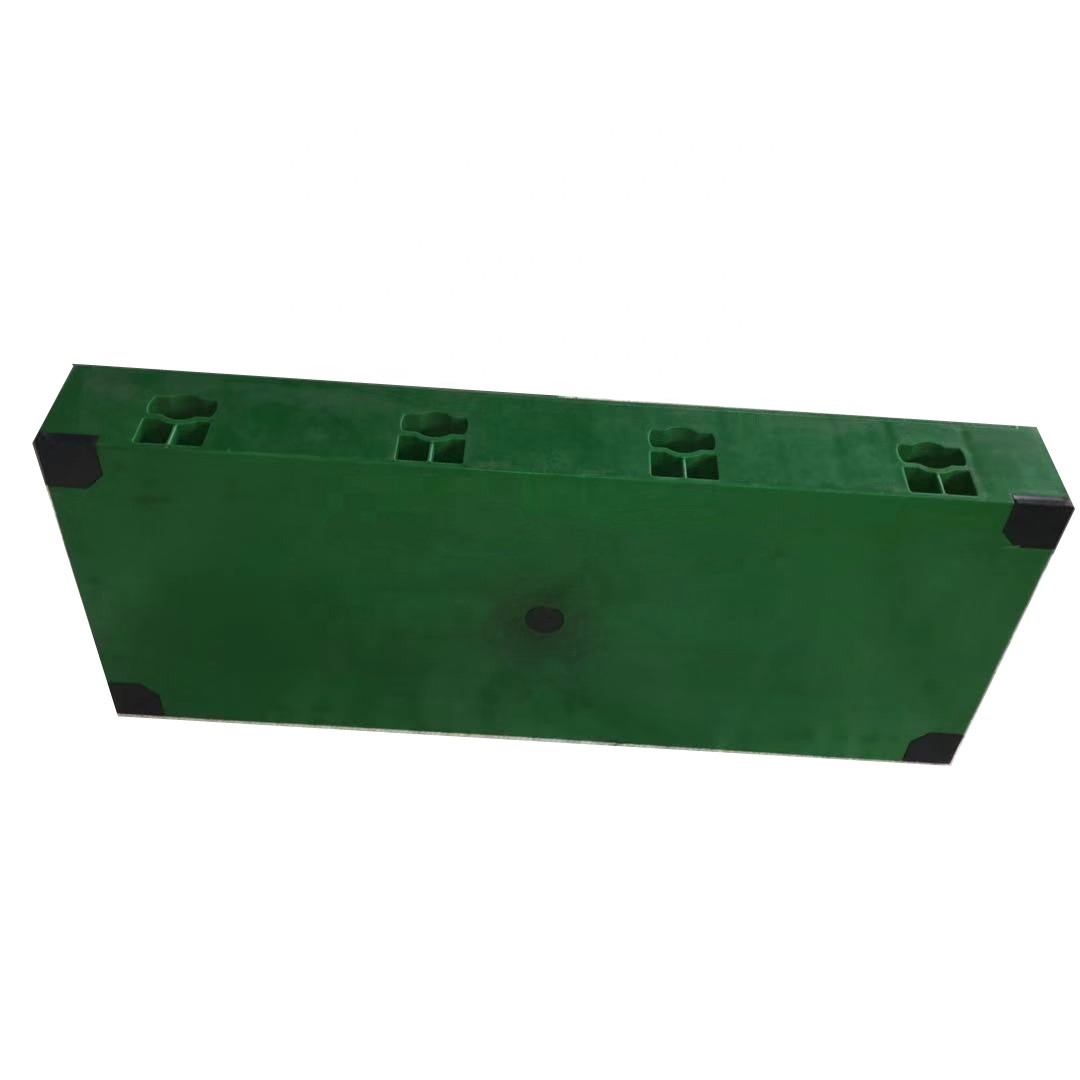
 Modular Formwork
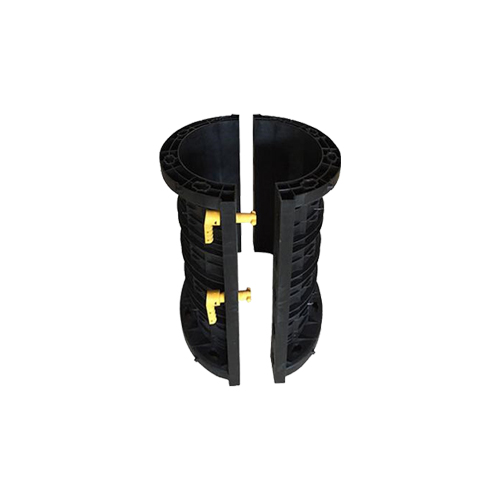 Column formwork

- Round and square column consistency depends more on stiffness, locking precision, and assembly discipline than on template price alone.
- A column formwork manufacturer should be evaluated by product range, tolerance control, reusable cycle count, and support for different column geometries.
- Concrete column formwork for repeat projects should prioritize stable dimensions, low leakage, and fast stripping to reduce rework.
- The right system is the one that fits the column section, pour height, finish requirement, and crew skill level.
How to choose column formwork for better round and square column consistency starts with one measurable question: can the system hold geometry under real site pressure, not just in a catalog? For formed concrete surfaces, tolerance management is not optional, and construction QA commonly references ISO 12491:2020 for verification principles. In practical terms, a well-controlled column formwork system should reduce edge drift, honeycombing risk, and joint leakage while maintaining repeatable setup across cycles. That matters whether you are sourcing from a column formwork manufacturer, comparing a concrete formwork range, or planning a project that also needs adjustable plastic formwork and ABS plastic formwork for other pours.
Why column formwork consistency matters for round and square columns
Column consistency is a structural and visual requirement, not only an aesthetic preference.
In buildings, columns often sit in exposed locations where even small dimensional deviations are visible immediately at eye level. A square column with uneven edges or a round column with an oval section can create alignment problems for beams, cladding, or decorative caps. More importantly, poor geometry can make stripping harder, increase patching time, and reduce reuse efficiency on the next pour.
Concrete column formwork must therefore do three things at once: keep the section true, resist wet concrete pressure, and allow fast, repeatable assembly. If one of those fails, the result is usually leakage at the joints, local bulging, or inconsistent cover thickness. Those problems are expensive because they compound after every cycle.
The practical benchmark is simple: if crews need extra shimming, repeated tightening, or onsite improvisation to make the pieces line up, the system is not stable enough for repeatable column work.
Column formwork system selection: the core factors that control geometry
Stiffness and locking accuracy are the two strongest predictors of column formwork consistency.
The form does not need to be the heaviest option; it needs to keep its shape under the real load of fresh concrete and vibration. For that reason, buyers should look at wall rigidity, corner reinforcement, connector design, and whether the system maintains a stable internal profile after repeated use. A strong surface alone is not enough if the joints shift by a few millimeters during tightening.
| Selection factor | Why it affects consistency | What to verify on site |
|---|---|---|
| Wall stiffness | Prevents bulging under fresh concrete pressure | Deflection behavior during mock assembly |
| Locking precision | Keeps round or square profile stable | Gap uniformity at every joint |
| Surface flatness | Improves finish quality and reduces patching | Visible waviness after repeated cycles |
| Strip efficiency | Controls cycle time and damage during removal | Ease of release after curing |
For procurement teams, a column formwork manufacturer should be asked for the dimensional range, recommended pour height, and maximum reuse target under normal maintenance. If those values are not documented, the system may be difficult to standardize across multiple project teams.
In parallel, concrete mix quality matters. ASTM C1602/C1602M-22 defines requirements for mixing water in concrete, and control of mix consistency affects pressure, surface quality, and final geometry. Formwork cannot fix a poorly managed mix, but it can either amplify or contain the problem.
Round column formwork versus square column formwork: what changes in practice
Round columns are more sensitive to circumferential distortion, while square columns are more sensitive to corner blowout and edge mismatch.
A Round Column Formwork system needs a continuous curvature that resists ovalization. If the shell flexes unevenly, the finished column may look acceptable from one angle and distorted from another. Square columns, by contrast, demand accurate 90-degree corners, clean chamfers, and consistent panel alignment. A 2 mm shift at one corner can become visible across the whole height.
| Column type | Main risk | Critical control point | Typical inspection focus |
|---|---|---|---|
| Round column | Ovalization | Uniform radial stiffness | Diameter consistency at top, middle, bottom |
| Square column | Corner drift | Corner lock strength | Edge straightness and corner squareness |
| Rectangular column | Uneven side pressure | Long-side reinforcement | Side-to-side dimension match |
When the project includes both round and square columns, flexibility matters. In that case, a modular system or an adjustable solution may be more efficient than a single fixed-size set. Product families such as round column formwork and square column formwork should be evaluated for geometry accuracy separately, even if they are sold by the same supplier.
Many buyers underestimate the difference between the two. Round columns reward uniform curvature and balanced tightening. Square columns reward precise edge contact and stable corner reinforcement. The formwork that performs well on one may not be the best choice for the other.
Material choices for concrete column formwork and their impact on repeatability
Material selection directly affects reuse count, surface quality, and dimensional stability.
ABS plastic formwork is often chosen for repeatable construction cycles because it offers a good balance of weight, surface release, and handling convenience. PC-based solutions are typically considered when projects need higher strength and more stable shaping. PP hollow boards can help when lightweight transport or auxiliary panel use is important. The best material depends on how often the form will be reused, how much load it must resist, and how exact the finish must be.
Traditional timber systems are familiar but more vulnerable to warping, moisture change, and edge damage. That is why reusable plastic formwork is often preferred for projects that value consistency across multiple pours. In practical procurement terms, a higher initial cost can still be justified if the system keeps its profile longer and reduces patching labor.
| Material | Strength/stability profile | Best use case | Operational tradeoff |
|---|---|---|---|
| ABS plastic | Balanced stiffness and usability | Repeatable wall and column work | Needs proper handling to preserve edges |
| PC plastic | Higher rigidity and stable forming | Higher precision projects | Usually higher cost |
| PP hollow board | Lightweight and easy to transport | Auxiliary panels and bulk procurement | Less suitable for the most demanding finish goals |
| Wood-based formwork | Easy to modify, less stable over time | Short-run or low-budget work | Lower reuse and more dimensional drift |
For buyers comparing a PP hollow board with a reusable column system, the key question is not only load capacity. It is whether the material will still deliver the same diameter or corner geometry on the tenth cycle as on the first.
How to judge a column formwork manufacturer before you buy
A reliable manufacturer proves consistency with data, not slogans.
Look for product sheets that specify dimensional ranges, assembly method, allowable reuse count, maintenance requirements, and compatible accessories. Ask whether the supplier can provide project photos, installation videos, and a complete list of matching components. Those details matter because column geometry often fails at the connection points, not in the panel center.
For distributor and contractor purchases, supplier clarity is critical. If the catalog does not clearly separate round, square, adjustable, and decorative column products, the risk of wrong selection rises quickly. A structured range such as roman column formwork and adjustable plastic formwork helps buyers compare by application instead of guessing from photos.
- Check whether the supplier documents material type and recommended use case.
- Ask for a sample assembly or mock-up to confirm fit and locking accuracy.
- Verify whether spare parts or replacement connectors are available.
- Review whether the system is suited for both exposed and concealed columns.
- Confirm packaging and shipping dimensions if the project is export or remote-site based.
On overseas projects, English technical sheets and clear installation guidance reduce decision friction. That is particularly useful when multiple teams are involved, because the same column formwork system must be understandable to procurement, engineering, and site supervisors.
Installation and maintenance steps that improve round and square column consistency
Most column defects come from setup errors, not from the concrete itself.
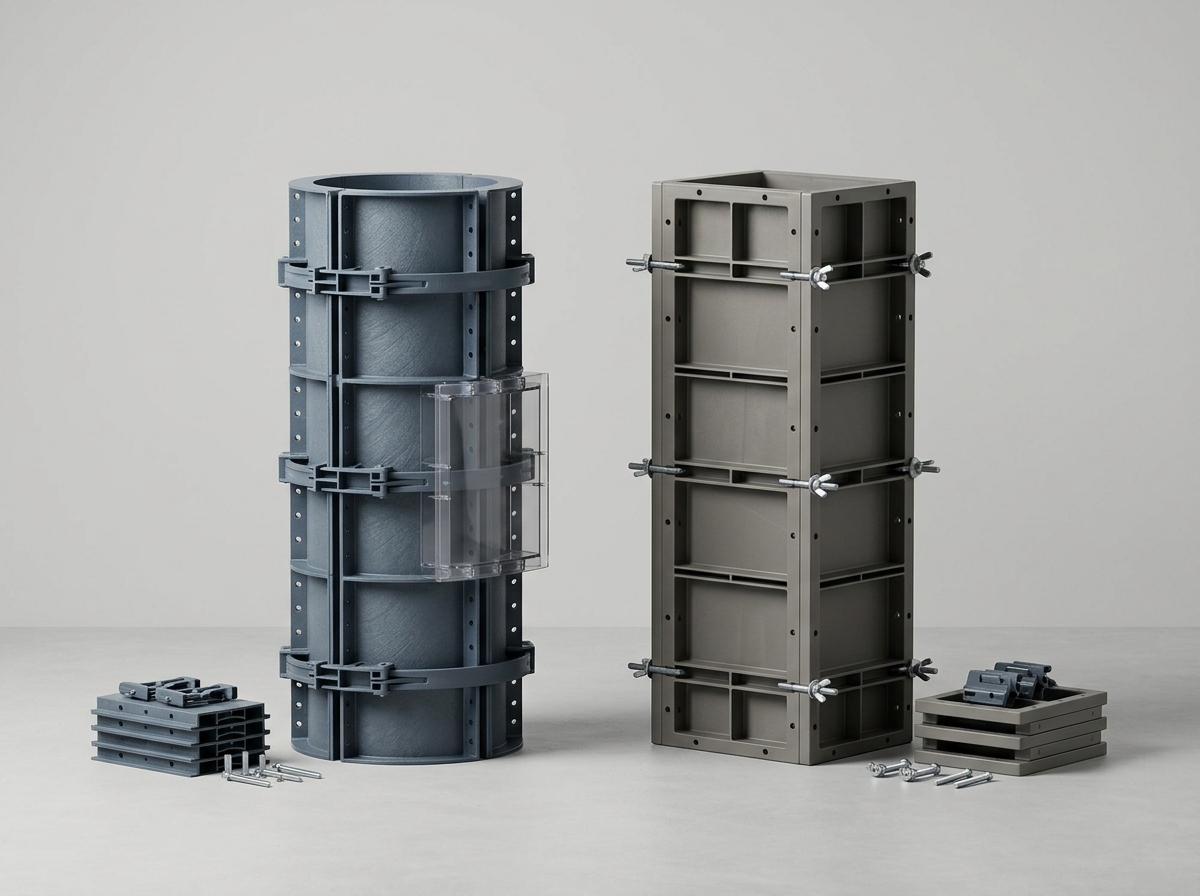
The best system still needs disciplined installation. Before each pour, crews should verify plumbness, base sealing, joint engagement, and internal cleanliness. If debris remains at the base or if a connector is only partially engaged, the profile can shift under load. For repeat work, a simple pre-pour checklist saves more time than last-minute adjustment.
- Clean the contact surfaces and remove hardened residue from previous cycles.
- Confirm the base is level and the column centerline is marked correctly.
- Assemble panels in the same sequence every time to reduce fit variation.
- Check all locks, braces, and ties before concrete placement begins.
- Monitor the first lift of concrete for leakage, movement, or local swelling.
- Strip only after the concrete has reached a safe release condition.
Maintenance is equally important. Reusable systems last longer when edges are protected from impact, release agents are used correctly, and damaged connectors are replaced early. A small deformation at a corner or seam can repeat as a visible defect on every subsequent column.
For plant-managed inventory, the best practice is to assign each set an ID, record cycle count, and inspect after every stripping. That discipline turns a column formwork system into a controllable asset rather than a consumable guess.
Choosing by project scenario: low-rise, commercial, and decorative columns
Different projects require different consistency targets.
Low-rise residential work usually values fast turnover and simple handling. Commercial towers often prioritize repeatability across many floors, so panel consistency and stripping speed matter more. Decorative and landscape columns place more emphasis on surface finish, curvature control, and visual symmetry. The same column formwork manufacturer may serve all three, but the recommended product should not be the same for each scenario.
| Project scenario | Primary priority | Best system characteristic | Risk if mismatched |
|---|---|---|---|
| Low-rise housing | Speed and labor efficiency | Fast assembly, light handling | Slow cycle time |
| Commercial building | Repeatability across cycles | Stable locking and edge control | Geometry drift floor to floor |
| Decorative facade | Surface quality | High finish consistency | Visible patching and joint marks |
For projects that combine columns with other shaped concrete elements, category breadth is useful. A supplier that also offers walkway formwork or flexible garden formwork may indicate stronger experience with both standard and non-standard geometry, which can help when the project includes mixed-form applications.
What real consistency looks like in column formwork procurement
Consistency should be judged by observable outcomes on the finished column.
A good system produces smooth joints, even edges, and predictable dimensions from one pour to the next. A poor system looks acceptable on paper but shows variation in diameter, corner sharpness, or verticality when compared across cycles. This is why mock-up testing is more useful than brochure comparison alone.
Procurement teams should ask for three things before final approval: a sample assembly, a tolerance description, and a maintenance plan. If the supplier cannot explain how the system preserves geometry after repeated use, the buyer is not evaluating a true column formwork system.
In the broader construction standards environment, quality control is tied to documented verification rather than visual impression. NIST construction resources emphasize the importance of measurement and calibration in construction-related processes, which is directly relevant when a project demands repeatable column dimensions and consistent alignment.
Conclusion: the best column formwork system is the one that controls geometry, not just cost
The most reliable way to choose column formwork is to start with the end result you want: a round or square column that stays true in size, shape, and finish across repeated pours.
If the project needs consistent exposed surfaces, select a system with high locking precision, sufficient rigidity, and a documented maintenance path. If the project mixes round and square sections, prioritize modularity and clear category separation. If the project is repetitive, focus on reuse stability rather than lowest purchase price.
In practice, the best concrete column formwork is the one that reduces correction work after stripping and keeps the next pour as predictable as the last. That is the real measure of a strong column formwork manufacturer and the real reason consistent geometry pays back over time.
FAQ: column formwork manufacturer and concrete column formwork selection
1. What is the most important factor when choosing column formwork?
The most important factor is dimensional stability under load. If the system cannot hold its profile during concrete placement and vibration, round and square columns will drift out of tolerance.
2. Is reusable plastic formwork better than wood for columns?
Reusable plastic formwork is often better when repeatability, lower damage, and cleaner stripping are priorities. Wood is easier to modify, but it usually loses geometry faster across cycles.
3. How do I know whether a system is suitable for both round and square columns?
Check whether the manufacturer offers dedicated round and square profiles, plus clear locking accessories and dimensional ranges. A one-size-fits-all approach usually compromises consistency.
4. What should I ask a column formwork manufacturer before buying?
Ask for material specification, recommended reuse count, assembly method, allowable pour height, and sample installation guidance. If possible, request a mock-up or project reference.
5. Why do square columns often show corner defects?
Square columns are especially sensitive to corner pressure and connector alignment. Even small misfits can create corner swelling, edge mismatch, or visible patch marks.
6. Can formwork quality affect concrete surface finish?
Yes. Surface flatness, leakage control, and stripping behavior all influence the final finish. Poorly aligned panels usually leave more repair work.
7. What standards should be checked during procurement?
For verification and material control, review ISO 12491:2020 for quality management principles in building construction and ASTM C1602/C1602M-22 for concrete mixing water requirements.