
 Modular Formwork
 Column formwork

- Waffle slab moulds reduce dead load by replacing solid concrete with engineered voids.
- Weight reduction improves structural efficiency, but the slab still needs proper reinforcement and design verification.
- Project success depends on mould geometry, spacing, reuse rate, and compatibility with the formwork system.
- Useful technical references include NIST guidance on concrete structural design and ISO 22965-1.
Waffle slab mould systems are a practical way to reduce slab weight while maintaining a strong structural grid, and the design logic is easy to understand: remove concrete where it contributes least and keep it where it contributes most. According to FHWA bridge and structural design guidance, dead load control is one of the most important levers in structural efficiency, because every kilogram removed from the slab reduces demand on beams, columns, and foundations. In modern building practice, that is why a waffle slab mould supplier is often evaluated not only on mould durability, but also on how well the mould system supports consistent void formation, fast stripping, and repeatable slab geometry.
How a waffle slab mould reduces slab weight in a voided slab system
The core mechanism is straightforward: a waffle slab mould creates a voided slab system that replaces unnecessary concrete mass with air-filled cavities. The slab becomes a network of ribs and topping, which shifts material into structurally efficient zones. In a typical two-way slab, the bottom surface in the center span sees tension, while the regions between ribs contribute less to flexural resistance. By using moulds to form voids, the slab can achieve a lower self-weight without turning into a weak or thin section.
This matters because dead load is permanent load. If the slab is lighter, supporting members can often be optimized, and the building may require less total concrete and reinforcement in the superstructure. The weight reduction is not just a comfort benefit; it can influence column sizing, foundation reactions, and even seismic response in certain structural systems. For that reason, engineers usually treat the waffle slab mould as a system component rather than a standalone accessory.
| Design factor | Typical effect in a voided slab system | Why it matters |
|---|---|---|
| Void creation | Concrete is removed from low-stress zones | Reduces dead load |
| Ribbed geometry | Material concentrated in load paths | Improves stiffness efficiency |
| Lower self-weight | Less permanent load on supports | Can reduce demand on beams and columns |
| Reusable moulds | Repeated casting with stable geometry | Improves consistency and cost control |
Why waffle slab mould geometry matters for structural efficiency
The mold geometry determines how effectively the slab saves weight without compromising performance. The conclusion is simple: rib spacing, void depth, and topping thickness control whether the slab behaves efficiently or merely looks hollow. When the geometry is poorly selected, the project can lose stiffness, complicate reinforcement placement, or create finishing issues.
In structural terms, designers often balance three variables: span, load, and slab depth. A deeper ribbed section can increase bending efficiency, while too much void depth can make serviceability harder to manage. This is why procurement teams should ask a waffle slab mould supplier for dimension drawings, load assumptions, and installation sequence, not just product photos. A well-made mould should support repeatable void formation and clean release, because slab consistency is essential when large floor areas are poured in batches.
| Geometry variable | What it changes | Typical design concern |
|---|---|---|
| Void depth | Weight reduction and stiffness balance | Serviceability and deflection |
| Rib spacing | Load distribution pattern | Crack control and vibration response |
| Topping thickness | Surface strength and fire performance | Reinforcement cover and finish quality |
| Mould repeatability | Uniformity across pours | Tolerance control |
For concrete materials and design rules, ISO 22965-1 provides a framework for concrete specification and compliance, while ASTM C31/C31M sets a standard practice for making and curing test specimens, which is useful when verifying whether a voided slab system is meeting expected performance. These references matter because weight reduction only makes sense if the slab still performs as designed.
Waffle slab mould supplier selection criteria for commercial projects
The right supplier is the one that helps the project control risk, not just cost. A reliable waffle slab mould supplier should provide verified dimensions, material information, reuse expectations, and installation guidance that fits the site workflow. For contractors, the biggest hidden cost is often not the mould itself, but delays caused by poor fit, slow stripping, or inconsistent casting cycles.
When comparing suppliers, it helps to evaluate the entire system around the mould. That includes compatibility with shoring, release agent use, edge detailing, and reusability under site conditions. If the project is part of a larger formwork package, consider whether the supplier also offers related products such as column formwork or wall formwork, because coordinated systems can simplify procurement and reduce mismatch risk.
| Supplier check | What to ask | Acceptable evidence |
|---|---|---|
| Geometry control | Are dimensions consistent batch to batch? | Drawings, tolerance notes |
| Reuse cycle | How many casts are expected? | Project references or test data |
| Installation support | Is the stripping sequence documented? | Manual, video, method statement |
| Compatibility | Does it fit the shoring system? | Assembly details and site plan |
For quality and testing, NIST structural concrete guidance is useful because it reinforces a basic engineering principle: the actual performance of a slab system should be validated against assumptions, not judged by appearance alone. In practical procurement, that means asking for dimensional drawings, assembly logic, and case references from similar projects.
How weight reduction affects cost, schedule, and performance
The best outcome is not simply a lighter slab; it is a floor system that uses less material per square meter while still meeting structural goals. In many projects, a voided slab system can reduce concrete volume in the slab body and also lower the weight carried by columns and foundations. That can create downstream savings, although the exact effect depends on the span, load class, and structural design.
From a construction management perspective, the benefit often shows up in fewer truck deliveries, less manual handling, and cleaner repetition on site. The mould must therefore support a stable cycle. If stripping is awkward or the mould deforms, the labor savings disappear quickly. Many project teams discover that consistency is more valuable than one-time cost reduction.
| Project impact area | How lighter slabs help | What can offset the benefit |
|---|---|---|
| Concrete use | Less slab mass to place | Poorly optimized geometry |
| Support load | Lower dead load on structure | Excess topping thickness |
| Labor | More repeatable casting rhythm | Slow mould cleaning |
| Schedule | Faster cycle on repetitive floors | Complex rework after stripping |
For test methods and acceptance planning, ASTM C39/C39M is widely used for compressive strength testing of concrete cylinders. That matters because a lighter slab still needs to achieve its specified strength before formwork removal and service loading. In other words, the weight reduction comes from geometry, not from weakening the material.
Where waffle slab moulds fit inside broader formwork strategy
Waffle slab moulds work best when they are integrated into a broader formwork strategy, not treated as a one-off item. The conclusion is clear: a project that already uses standardized Plastic Formwork can often benefit from better logistics, easier cleaning, and more predictable reuse. This is one reason procurement teams often compare waffle slab moulds alongsideABS plastic formwork and PP hollow board when planning a multi-product package.
In site practice, standardized formwork also supports faster crew training. Workers learn a repeatable assembly pattern, which reduces installation error and improves finish quality. That becomes especially useful on large projects with multiple pours, where even small inconsistencies can compound over time. For overseas buyers, a supplier that offers clear drawings and English documentation can lower transaction friction and speed approval.
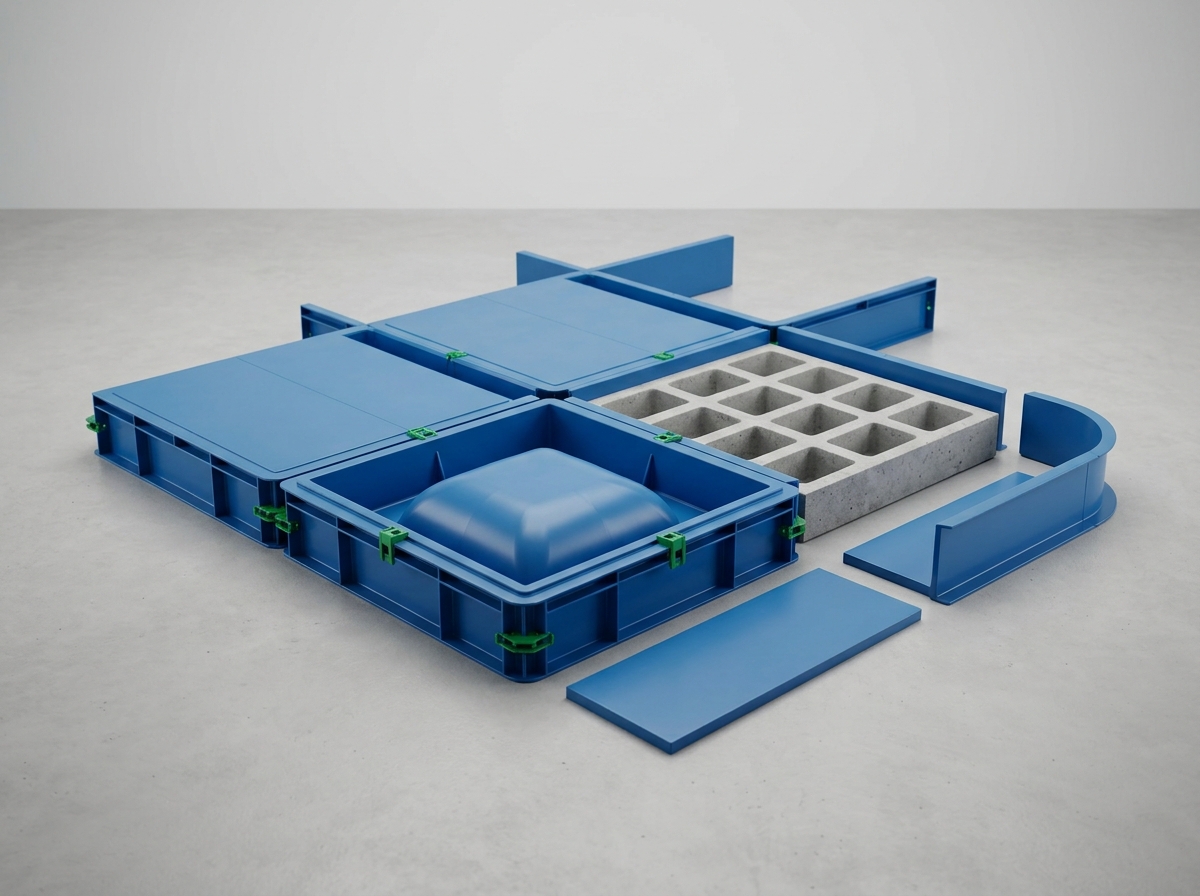
- Check whether the mould system matches the project span and loading class.
- Confirm stripping sequence and reuse expectations before purchase.
- Verify compatibility with shoring, reinforcement, and edge detailing.
- Request reference projects with similar slab thickness and bay size.
Practical installation considerations for a voided slab system
Installation quality has a direct effect on both slab weight and finished performance. The best result comes from precise layout, stable support, and disciplined concrete placement. If the mould floats, shifts, or traps air, the geometry can be compromised and the intended weight reduction becomes less reliable.
A site team should treat the mould layout as a measurement task. The grid must be aligned, the supports must be level, and the pour sequence should avoid displacing the void formers. During vibration, crews should use enough consolidation to eliminate honeycombing without moving the moulds. After curing, stripping should be done according to the approved method statement.
- Verify slab layout and support spacing before placing moulds.
- Confirm mould positioning, clearances, and reinforcement cover.
- Place concrete in controlled lifts to avoid displacement.
- Inspect curing and strength before stripping the system.
- Document reuse and surface condition for the next cycle.
These steps are consistent with good concrete practice, and they also protect the economics of the system. A voided slab system only delivers value if it can be repeated cleanly across many bays.
Comparison table: solid slab versus waffle slab mould system
The clearest way to understand the benefit is to compare the two slab concepts side by side. The right choice depends on structural span, serviceability limits, and construction sequence.
| Item | Solid slab | Waffle slab mould system |
|---|---|---|
| Dead load | Higher | Lower due to voids |
| Concrete usage | More material per area | Less material in low-stress zones |
| Span efficiency | Good for shorter spans | Often better for longer spans |
| Formwork complexity | Lower | Higher but repeatable |
| Best use case | Simple floor plates | Projects needing weight reduction |
The practical lesson is that a waffle slab mould is most valuable when the project has enough repetition to justify the setup. If the floor plan is highly irregular, the system can become less attractive. If the bays are repetitive, the system often becomes easier to justify.
FAQ
How does a waffle slab mould help reduce slab weight?
It reduces slab weight by forming voids inside the slab so less concrete is used where it contributes little to structural resistance.
Is a voided slab system weaker than a solid slab?
Not necessarily. A properly engineered voided slab system can be efficient because it places material in ribs and topping where structural demand is higher.
What should I ask a waffle slab mould supplier before buying?
Ask for geometry drawings, reuse expectations, installation guidance, and compatibility with your shoring and reinforcement plan.
Which standards are useful when verifying concrete performance?
Common references include ASTM C39/C39M, ASTM C31/C31M, and ISO 22965-1.
When is a waffle slab mould a better choice than a solid slab?
It is often better for repetitive floor plans, longer spans, and projects where dead load reduction can improve overall structural efficiency.
What is the biggest installation risk?
The biggest risk is mould movement during concrete placement, which can distort the void geometry and reduce performance consistency.
Can waffle slab mould systems reduce project cost?
They can, especially when lower dead load reduces downstream structural demand and the system is reused across many pours.